
RICHARD STRAUSS
Der Rosenkavalier – Suite Op. 59
Four Last Songs Op. posth. (texts by Hermann Hesse and
Joseph von Eichendorff)
JOHANNES BRAHMS
Symphony No. 3 in f Major Op. 90
Madeleine Pierard (soprano)
Sir Donald Runnicles (conductor)
New Zealand Symphony Orchestra
Michael Fowler Centre, Wellington
Friday, October 2nd, 2026
Review for Middle C by Peter Mechen
What a glorious concert! – firstly, in the space of less than an hour and across the span of two otherwise unconnected compositions, we were caught up in a contrivance of enchantment, thanks to composer Richard Strauss and his characteristic depictions of life and love in both human and fairy-tale terms. First was an orchestral suite from his opera “Der Rosenkavalier”, one straightaway drawing candid and sympathetic references to youth and age in the various depictions of the work’s key moments – and then, with the composer’s final composition, his “Four Last Songs”, came the tranquil inevitability of both nature and human life taking their full interactive courses.
We enjoyed, in the concert’s opening, the exuberance of youth in the Prelude to the opera as the young hero, Octavian, the title’s “Knight of the Rose” makes passionate love to his mistress, the beautiful Marschallin (Mrs. Field-Marshal) making use of the convenient absence of her husband, while knowing all along that she will in time lose her”knight” to a younger woman. The story quickly addresses this circumstance, as Octavian is sent away by the Marschallin to be the Bearer of the Silver Rose of Betrothal to a young girl, on behalf of the “real” would-be-suitor – but in the process Octavian himself falls deeply in love with the intended bride-to-be, Sophie, who, as per usual in these situations, reciprocates.
Trouble inevitably ensues between the gallant Rose-bearer and the prospective Bridegroom, the boorish Baron Ochs, who’s then wounded in a brief skirmish between the two, after which Octavian himself sets a trap for the profligate suitor (returning to the scene in the disguise he had already affected as the chambermaid whom the Baron had previously ogled on a previous visit to the Marschallin!) Anticipating his “good luck” via a sexy waltz tune the foolish Baron is of course subsequently exposed, disgraced and sent packing, while the remaining “trio” of would-be-lovers express in a famous three-way exchange the situation’s complications and resolutions. Octavian and Sophie are left together alone to sing a final duet which proclaims their union and ends the opera – though the suite’s conclusion hearkens back to the riotous music accompanying Baron Och’s none-too-graceful withdrawal from the scene.
Despite the opera’s title, the story’s central character is the Marschallin whose story, briefly told, epitomises a kind of “Frauenliebe und Leben” scenario though one vastly different to Robert Schumann’s famous song-cycle – the Marschallin, in contemplating her affair with her young lover Octavian recalls her own earlier experience as a young girl, with, like Sophie, its arranged marriage, and her eventual turning to affairs for emotional fulfilment.
Following the suite we were then taken to the world of Strauss’s “Four Last Songs” whose opening setting also suggests the trappings of young love, if through the poet’s older eyes, and with the return of the Spring in “Fruhling” used as a symbol of love’s renewal. In the same symbolic fashion the words of September farewell the Summer as Autumn turns the leaves to gold as each one falls from the tree; while the third song, Bein Schlafengehen (Time to Sleep) equates the day with a life’s work, and sleep while obeying life’s “deeper laws” of rest, allowing the soul to be set free. How infinitely touching, therefore, is the final song Im Arbendrot (At dusk), where a life of shared love is epitomised by pairs of woodwinds imitating the two skylarks taking flight as the music inexorably surrenders to nightfall, and to “Stiller Friede” (Silent peace), with the song’s final line “Ist dies etwa der Tod?” (Can this perhaps be death?)
All of this was the course taken by the concert’s first half – exuberant and resplendent at the beginning, as young love has every right to be, and splendidly and quixotically plotting and achieving its course throughout the “Rosenkavailer” music. Conductor Sir Donald Runnicles vigorously and viscerally encouraged the orchestral depictions of the lovers’ extra-marital congress (what wonderful, orgasmically-whooping horns!), even if the “afterglow” ironically took us abruptly to the scene of the Rose’s Presentation by Octavian to Sophie with all due pomp and ceremony. This prompted some of the most exquisite writing (winds, harp, celesta and muted violins) ever to be crafted for opera – the playing here was as exquisite and heart-rending in its beauty as any performance I’ve previously heard, those famous “rose chords” variants of the theme first heard played by the strings at the opera’s beginning after the opening horn call! They of course represented the Marschallin as much as they did Sophie, depicting moments of time that resembled glimpses of eternity in their “transported” nature, though subject, like everything else, to time’s passing.
The undoing of the boorish Baron, victim of his own salacious instincts, was unreservedly expressed by his lascivious waltz-tune, outrageously distended with self-satisfaction in places, and, here, spared no indulgence by conductor Runnicles with his players, to our great delight! Then came the opera’s final scenes, firstly the great vocal Trio of self-abnegation whose lines were given heartfelt emotional juice befitting each character’s conflicting emotion and resolution, tender solo violin, oboe and horn lines gradually subsumed by the full orchestral panoply at the climax – but just as moist-eyed for me was the effect of the lovers’ final duet, punctuated by those haunting “rose” chordings once again! Here, there was just enough closure to allow the music to jump outside the opera’s strict chronology and finish with the ever-imperturbable Baron’s exit music, the character bloodied but nevertheless unbowed, as demonstrated by the animal vigour of the orchestral playing of yet another, more exuberant waltz-tune, conductor and players pulling out, as the saying goes, all the stops in a spectacularly brilliant orchestral display.
Love’s youthful dream was then taken on a life-journey, a perspective reaching fulfilment in the aging composer’s “Four Last Songs”, a product of his final, reflective years, and the result of two of his passions, intertwined in his love for his wife, Pauline and for the soprano voice (as Pauline de Ahna, she was herself an accomplished operatic soprano). Written the year before Strauss’s death, and written for the great Kirsten Flagstad, these songs had to wait until 1950 to receive their first performance by Flagstad, with Wilhelm Furtwangler conducting the Philharmonia Orchestra in London’s Festival Hall – incidentally, the title of the work and the order of the songs were not the composer’s but contrived by the publisher.
With so many previously-admired performances sounding in my ears I was obviously interested with how I would react to Madeleine Pierard’s singing of such an iconic work (with any much-recorded “classic”, always a fascinating experience!). Suffice it to say that I didn’t wish at any time for a single note or phrase of hers to be delivered otherwise, so much did I “grow into” her voice’s ambient presence, generating colour and tonal responses which for me “went with” each of the songs’ structural and emotional journeyings. As I’ve observed on previous occasions I’d heard and observed Pierard, she “owns” so profoundly the text of anything she sings – as was the case here, across the emotional gamut of the four “same-but-different” songs. Both singer and conductor moulded the energies of the words of “Fruhling” (Spring) with a freshness and clarity that grew with the song’s blossoming, in places like “von deinem Duft und Vogelgesang” (Of your scents and the songs of birds) and then in the radiance of “Wie ein Wunder vor mir” (like a wonder before me). as nature reveals its charms.
The yearning melancholy of the next song, “September”, vied with autumnal beauties, so that one felt the sadness of the singer’s “Der Garten trauert” (The garden mourns) and also later, at “terbenden Gratentraume” (dying Garden dreams), and, just before the beautiful horn solo at the song’s end, with “müdgewordnen Augen zu” (tired eyes closed). I also enjoyed the gentle, “out of the ether” opening of “Beim Schlafenhegen” (While going to sleep), leading to NZSO leader Vesa-Matti Leppanen’s gorgeous violin solo, and the singer’s rapturous response, beginning with “Und die Seele unbewacht” (And my soul, unobserved), and relishing “…..im Zauberkreis der Nacht” (in the magic circle of the night)…….
As for the final Eichendorff song “Im Abendrot” (At Dusk) (the others were settings of Hermann Hesse), this was a gorgeous, spaciously- delivered “passage into eternity”, from the positive, life-affirming orchestral opening – and the confidently-floated words “Wir sind durch Not und Freude gegangen Hand” (We have gone through Joys and distress hand in hand), the music transcendent in its timeless beauty as the voice acclaims “O weiter, stille Friede” (O vast and silent peace!) before both vocal and instrumental tones are magically transmorgrified, it seems, into a timeless state of non-being the voice becoming “as yesterday’s sev’n thousand years” with the words “Ist dies etwa der Tod?” (Could this perhaps be death?)– everything so rapturously calm and eventually still as sleep overtakes, and life ebbs away. In the ensuing silence before the applause I suddenly felt that it couldn’t have been played and voiced better than what we heard on this occasion, and that we were blessed by it all.
Strauss’s unequivocal celebration of life and acceptance of death made the music of the concert’s second half sound more than usually enigmatic – this was the Third Symphony of Johannes Brahms, a work I’ve always regarded with a degree of bemusement after each encounter, as I’m invariably left with a disconcertingly different impression of “what this music might be about!”– this is hardly a revolutionary or jaw-droppingly unique response to music and its performance in general, of course, but in the case of this work it’s an ongoing process of interaction. Here, my encounter with Sir Donald Runnicles’s vitally-urgent performance of the opening movement brought out the piece’s drama more than usually for me, and especially with the first-movement repeat observed for good measure (not always!). I especially enjoyed the dramatic and deep-toned swirling aspects of the music’s central section, led by the horns, whose heroic tones repeatedly put one in mind of Robert Schumann’s “Rhenish” Symphony (also a “No. 3!”).
The work’s two middle movements emphasised the work’s lyrical qualities, the Andante swiftly and deftly dancing its way through a pastoral setting, with delicious exchanges between the winds and lower strings at the beginning, and moments of full-throated song vying with circumspectly “signalling” notes, as if the music was giving itself directions and go-aheads! – the Poco Allegretto movement which followed was more serious stuff, a long-breathed theme soulfully intoned firstly by the ‘cellos, and then the rest of the strings, and taken up also by a “wind choir of oboe, flute and horn. These had also a disconsolate-sounding contrasting theme which the strings attempted to “cheer up”, but to no avail – it was left to the solo horn to try and save the day, returning to the opening long-breathed theme, and emboldening the oboe to ”give it another try”! More discussion led to the strings’ rendition of the melody (gorgeous-sounding!) – but the movement’s highlight was the concerted, heart-bursting effort of the whole orchestra in giving sonorous, hymn-like voice at the end to the melody’s complete span (climbing from C to B-flat) and returning to its beginning – almost like a solemn act of homage to music itself!
Came the finale, something of a mini-drama in itself, with its sotto-voce opening on strings and bassoon, almost like undercover preparations being made for an oncoming conflict, with a theme which first appeared in the Andante movement, and here used as a kind of “warning” for the heavy brass to sound the alarm before the first shots were fired (or the invaders came over the wall!). The mood was intrepid, but flexible – sharp-edged and syncopated in its minor-key aspect, and warmly heroic in the major, alternating the moods and energies to what seemed almost like exhaustion point, before quietly drifting back to the symphony’s beginning, with its distinctive F-A-F chord progressions. For the composer those notes represented the words “frei aber froh” (free but happy) – Runnicles’ vividly-characterised performance with the NZSO players readily gave, I thought, the composer’s delight in such feelings, however enigmatic, their full and sonorous measure!
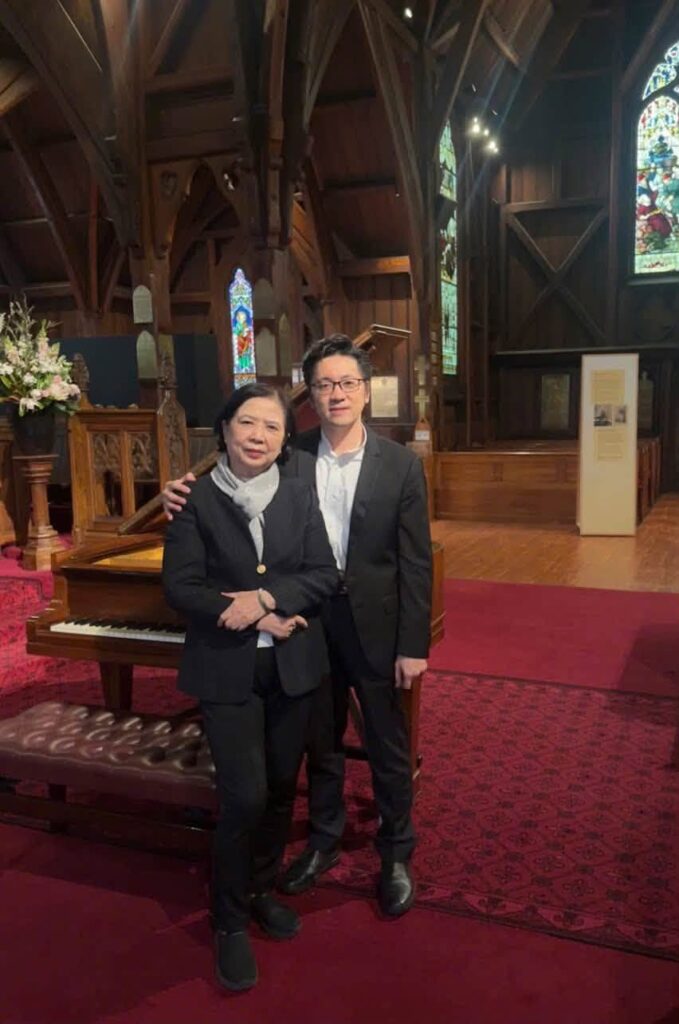 Quang Hong Luu, with
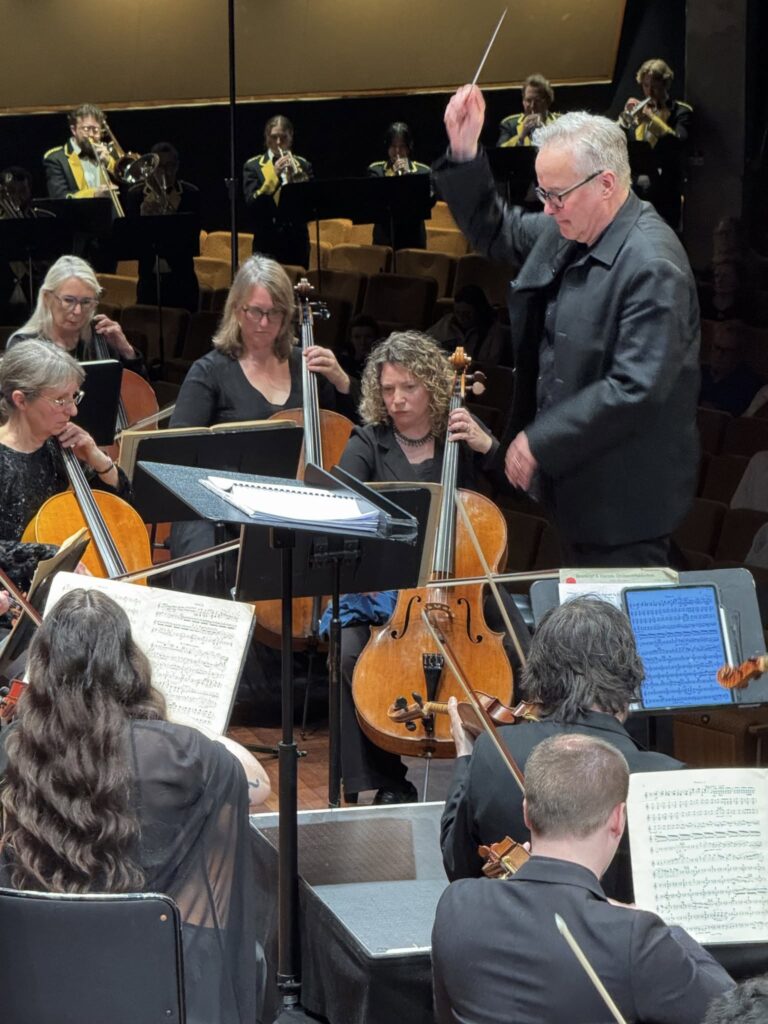 Marc Taddei with Orchestra Wellington and Wellington District Brass Ensemblepresents “Colossal”
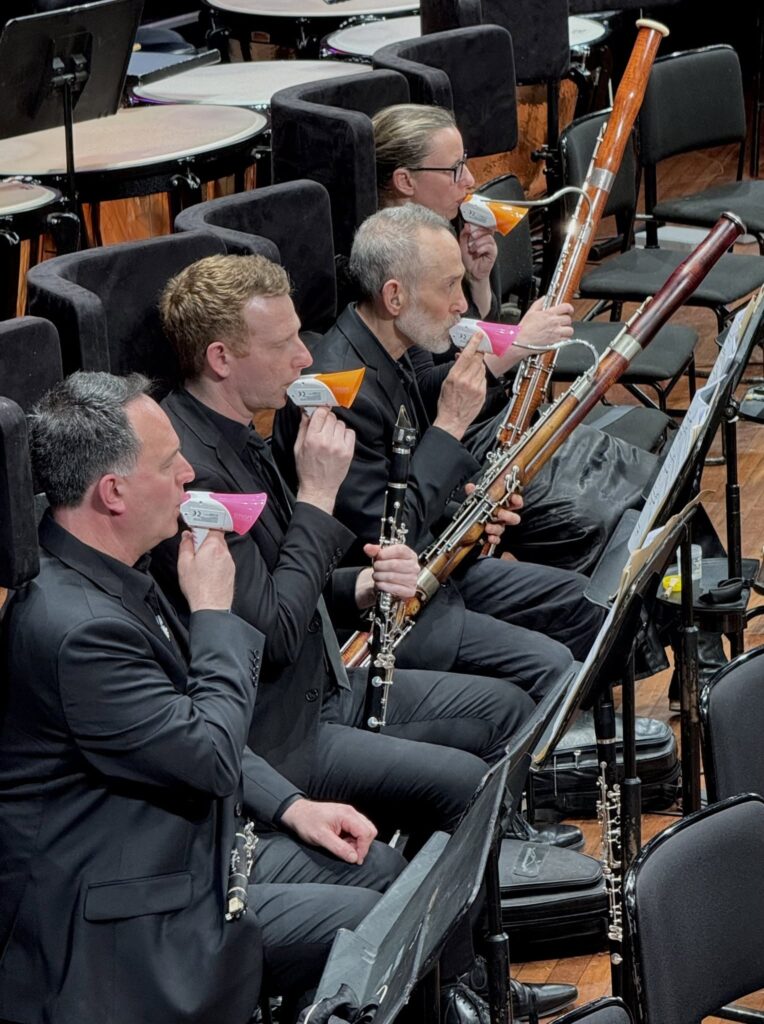 What could be taken on surface value for a magical fairytale sound-world of course had darker, bleaker and more ruinous implications, with Pearson’s evocative instrumentations graphically illustrating both the destabilising action and effects of increasingly confrontational weather-patterns and resulting conditions threatening present living environments with eventually uninhabitable conditions. Hand-in-hand with the ”thriil” of these near-virtuosic orchestrations came, of course, the realisation for us that these spectacular evocations were portents of doom in a sobering, “for whom the bell tolls” kind of way – all the more credit to the composer, therefore, in sounding so graphic a warning to humanity at large. The conclusion of the piece underlined its grim message with the players gradually enveloped in darkness as the sounds faded to silence. As befitted the piece, its presentation and performance, the reception at the end was overwhelming, with the composer making a warmly-acclaimed appearance!